
How to Buy Banarasi Sarees Online Without Getting Scammed (2026 Buyer's Guide)
The Banarasi saree market online has a real problem. Power loom copies get listed as handwoven all the time. Synthetic fabrics get sold as pure silk. A lot of listings don't carry any certification at all. Most buyers don't lose money because they were careless. They lose money because no one ever showed them what to actually check before they hit "buy now."
This guide fixes that gap. Before you order a Banarasi saree online, you should know how to spot an imitation just by examining the fabric, what the Silk Mark and GI tag are actually certifying, which weave suits which occasion, what a fair 2026 price looks like, and how to size up a seller before you pay them. If you'd rather start from a collection that already builds these checks in, authenticated fabrics, clear descriptions, practical policies, The Surreal Store is a Varanasi rooted option worth a look. But first, the knowledge, so you can shop confidently anywhere.
How to tell a genuine handwoven Banarasi from an imitation
Most buyers check the front of a saree and stop there. The real test is the back. A genuine handwoven Banarasi has a neat, organised reverse, where motifs are anchored with short thread floats instead of long loose ends. The tension varies slightly across the weave too, because a human hand guided every pass of the shuttle, not a machine set to a fixed rhythm.
A power loom copy can look flawless from the front and still give itself away the moment you flip it over. Long floating threads on the back, mechanically uniform tension, symmetry that's a little too perfect. None of that signals quality. It signals a machine. Power looms simply can't reproduce the small human inconsistencies that define real handloom work, which is exactly why those inconsistencies are what you're hunting for. We've gone deeper on this comparison in Powerloom vs Handloom Sarees: Which One Should You Actually Buy in 2026? If you want the fuller picture.
What the silk and zari tell you
Real silk feels warm in your palm and gives a little resistance when you rub it. It's never slippery, never artificially stiff. Move it between your fingers slowly and you'll feel a real weight to it, something synthetic blends can't fake no matter how they're finished. Zari works the same way. Genuine zari has a soft, muted gold sheen, while imitation zari catches light more like a mirror. Pull a thread from an inconspicuous spot and imitation zari will often show a grey or white core underneath.
Small irregularities in the weave aren't flaws. They're the signature of handloom work. Oddly enough, a saree that looks too perfect under close inspection, with flawless, machine precise motifs throughout, is telling you the opposite of what you'd assume. That level of uniformity usually means no handloom touched it.
Selvedge details and loom marks
Check the edges. Genuine handloom Banarasi sarees often carry small pin marks near the selvedge, left behind from where the fabric was tied to the loom frame during weaving. Look too for tied off knots at colour changes, something a power loom can't replicate, since its threads run continuously with no pause built in. None of this is a defect. It's proof of where the saree actually came from.
Certifications that confirm authenticity: Silk Mark and the GI tag
Physical checks get you most of the way there, but online, you can't always touch the fabric before you buy. That's where certification becomes your second layer of proof.
What the Silk Mark actually certifies
Current Silk Mark labels carry a QR code or scratch code you can verify directly on the SMOI portal. Every label also has a tamper evident hologram and a unique alphanumeric serial number tied back to an authorised seller. If a tag is missing either the hologram or the serial number, treat that as a red flag, no matter how convincing the rest of the listing looks.
The GI tag, and what its absence tells you
A GI tag confirms the saree was actually woven in Varanasi, to government recognised standards. If a listing never mentions one, that's a fair signal the saree isn't authentically Banarasi at all, whatever the title says. "Banarasi" gets used loosely as a style label all the time. Plenty of power loom and semi silk sarees made nowhere near Varanasi wear that name. The GI tag is what tells the two apart.
Matching the right Banarasi weave to your occasion
Fabric choice isn't just about how a saree looks in photos. It determines whether you're comfortable through a five hour wedding function in April, and whether the drape actually reads well on camera at an evening reception. Getting this right at the listing stage saves you a genuinely disappointing wedding day.
Pure Mashru silk and tissue silk for bridal wear and receptions
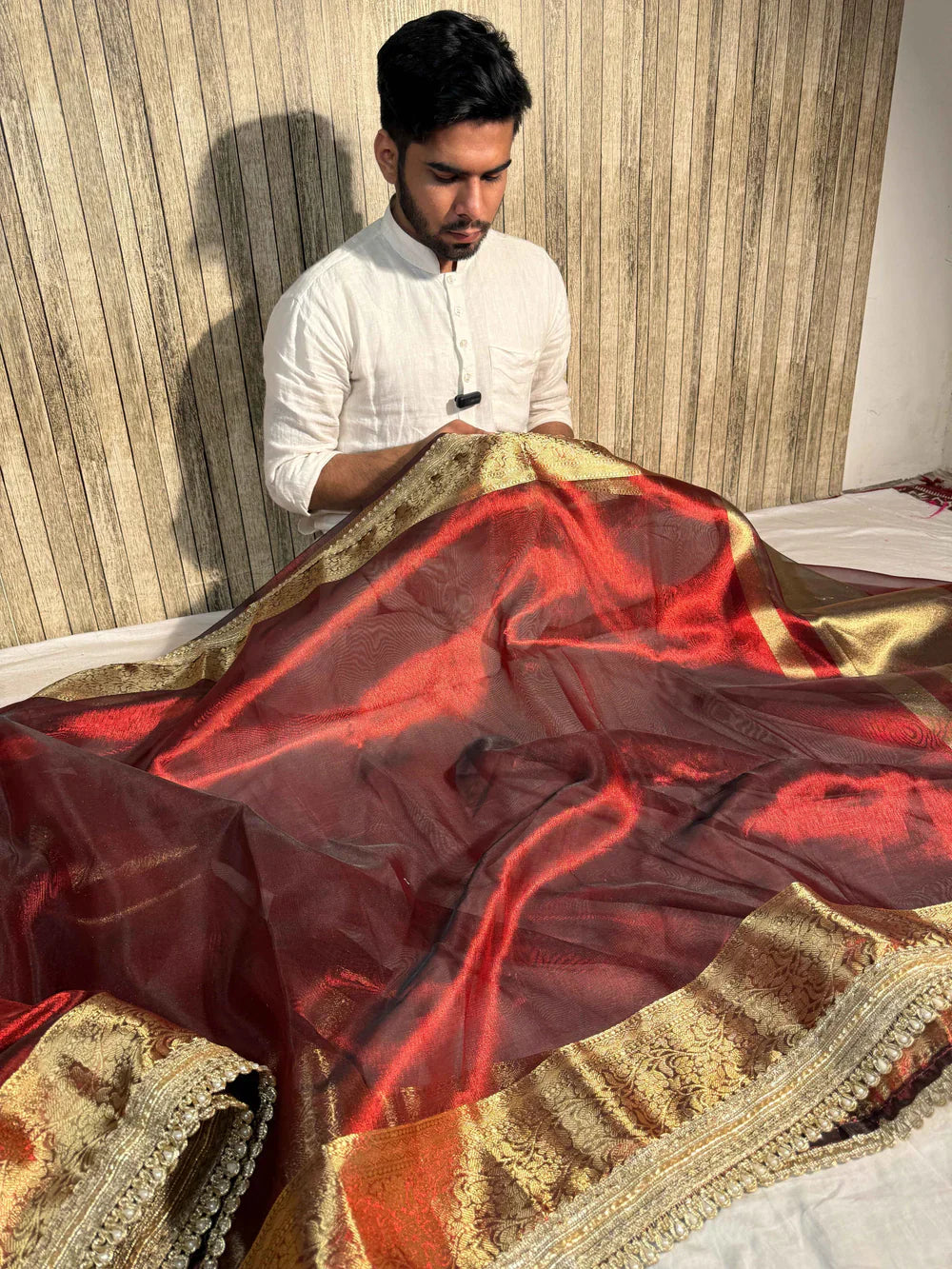
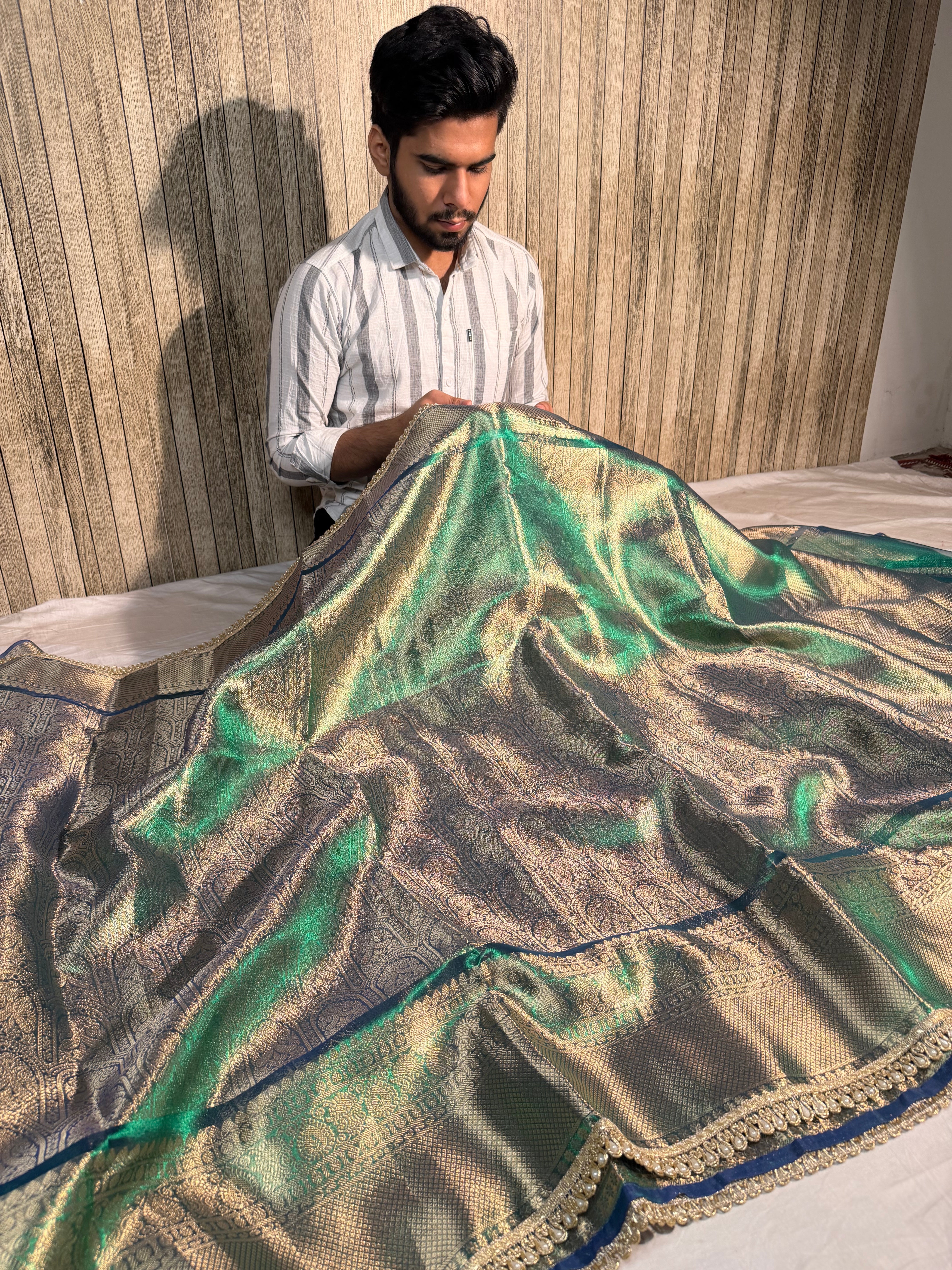
Pure Mashru silk is the heaviest, most traditional weave on this list, spun from two or more pure silk filaments twisted together. It falls into crisp, structured pleats and carries heavy gold zari well, which makes it the go to for bridal wear and formal ceremonies where you want real presence. The Banarasi tissue saree sits at the other end. It's lighter, more luminous, and genuinely photogenic. Its sheer, translucent quality is why it shows up so often at receptions and sangeets, where the fabric needs to catch light well both indoors and out.
Organza, Chiniya silk, and georgette for festivals and lighter occasions
Organza, Kora locally, is stiff and airy, and holds its shape rather than draping loosely. That structure suits heavy zari border work, which is why it's a festive season regular for evening events where a polished silhouette matters more than Katan's weight. Chiniya silk sits a notch lighter, keeping that signature Banarasi shine without the full heft of pure Katan, a comfortable choice for events that run long. Georgette is the most wearable of the three. Lightweight, easy to manage, and practical for anything stretching across a full day.
Mashru Katan and Ready to Wear for modern buyers
Mashru Katan blends silk and cotton, silk's lustre on the surface, cotton's breathability underneath, for buyers who want the Banarasi look without pure Katan's full weight. And for anyone who's never draped a saree before, or would rather skip the challenge entirely, Ready to Wear pre stitched styles deliver the same elegance with none of the learning curve.
Banarasi saree pricing in India, 2026: what to expect
Realistic price ranges are one of the simplest scam checks you have. Once you know what a fabric should cost, a mispriced listing stands out immediately.
- Georgette: ₹5,000 to ₹30,000 for handwoven retail pieces
- Organza: ₹16,000 to ₹1,60,000, depending on how intense the zari work is
- Tissue silk: ₹15,000 to ₹50,000 for standard handwoven pieces
- Pure Katan silk: ₹10,000 to ₹45,000 for standard retail, ₹50,000 and up for intricate Kadwa Jaal or Jamdani work
A listing offering "pure silk handwoven Banarasi" at ₹2,000 or ₹3,000 is almost certainly power loom, synthetic silk, or fake zari. Wholesale rates exist, but retail buyers aren't paying them. If a price feels too good to be true, the fabric usually isn't what the listing claims.
What to look for in a seller
Now you know what authentic looks like and what it should cost. The next question is who to actually trust with your order. Not every online seller can point to a real Varanasi connection, describe their fabric precisely, or back their product with policies that hold up after you've paid.
What a trustworthy seller looks like
Look for a physical location in Varanasi, or a clearly stated relationship with Varanasi weavers. Listings should name the exact fabric, not just "Banarasi silk" and nothing more. And check for customer photo reviews on the product page itself, not just studio shots. Real photos show you the actual colour, texture, and fall in a way no professional shoot ever will.
Post purchase policy matters just as much as the product page. Cash on Delivery or another secure payment option, plus a clearly stated return window, are the last two signals of a seller who actually stands behind what they sell. Vagueness on either front is worth pausing over.
The Surreal Store curates its Banarasi range across Tissue Silk, Chiniya Silk, Organza Silk, Georgette Silk, and Mashru Katan, with Silk Mark certification on applicable pieces. The catalogue runs across bridal, festive, celebrity inspired, and everyday categories. The best selling sarees range is a fair starting point if you want a sense of what's actually working for other buyers. On top of the curation, there's free shipping across India, Cash on Delivery, Ready to Wear options, and multiple payment methods, all of which lower the barrier for first time buyers and anyone shopping for a gift.
Five checks before you confirm any order
Run through this before placing any Banarasi order, from any seller. Each point catches a failure buyers usually only discover after the payment's already gone through.
- Return window: Look for at least 7 days, enough time to properly examine a handwoven piece after delivery. Anything under 48 hours, or a window limited to manufacturing defects only, isn't much real protection at this price point.
- Unboxing video requirement: Check if the seller requires one as proof of damage. If they do, record it without fail the moment the parcel arrives. It's your only leverage if something's wrong.
- Blouse detachment condition: Most sellers won't accept a return once the blouse has been detached or altered. Confirm this before you remove any tags or separate the blouse piece.
- Payment method: Make sure COD or a trusted gateway is available. Steer clear of sellers who only take bank transfers or informal payment apps with no recourse if things go wrong.
- Certification in writing: For pure silk pieces, get Silk Mark and GI tag confirmation in writing through the listing or seller chat before you order, especially for higher value purchases. A seller worth trusting won't hesitate to put it in writing.
Give customer photo reviews real attention while you research. Genuine buyer photos show true colour under natural light, how the fabric actually falls when draped, and texture up close. These are often the whole difference between a saree that matches expectations and one that doesn't.
Buying a Banarasi saree shouldn't feel like a gamble
None of this takes expert level knowledge, just the right checks, applied every time. Confirm authenticity through the physical details and the paperwork: the reverse side, the selvedge, the Silk Mark hologram, the GI tag. Match the fabric to your occasion and budget using real price ranges, not guesswork. And pick a seller whose policies protect you after the saree arrives, not just before you pay.
If you'd rather start from a collection that's already built around these checks, The Surreal Store is a reasonable place to begin. Varanasi rooted, spanning bridal Katan through lightweight georgette and Ready to Wear, with free shipping and Cash on Delivery built in.
FAQs
- How can I buy an authentic Banarasi saree online? Choose trusted sellers with transparent product descriptions, Silk Mark certification, GI Tag information, customer reviews, and clear return policies. Always verify authenticity before placing an order.
- How do I identify a genuine handwoven Banarasi saree? Check the reverse side for handloom irregularities, inspect the zari quality, look for loom marks on the selvedge, and confirm Silk Mark and GI Tag certification whenever available.
- What is the average price of a genuine Banarasi saree in 2026? Handwoven Banarasi sarees generally start around ₹5,000 for Georgette styles, while Pure Katan Silk and premium bridal sarees can range from ₹10,000 to over ₹50,000 depending on craftsmanship.
- Is Silk Mark certification important when buying Banarasi sarees online? Yes. Silk Mark certifies that the saree is made from 100% natural silk, while the GI Tag confirms its Banarasi origin. Both help buyers make informed purchasing decisions.
- Which Banarasi saree fabric is best for weddings and festive occasions? Pure Katan Silk and Tissue Silk are ideal for weddings, while Organza, Chiniya Silk, Mashru Katan, and Georgette are excellent choices for receptions, festivals, and long celebrations.
- Why choose The Surreal Store for Banarasi sarees? The Surreal Store offers Varanasi rooted Banarasi sarees across multiple fabrics, detailed product information, Ready to Wear Sarees options, Cash on Delivery, free shipping, and trusted online shopping support.