
Designer Banarasi Sarees Explained: Fabrics, Weaves & Styling Guide (2026)
A lot of saree listings online call themselves "designer Banarasi," and most of those labels mean very little without context. Search for a Banarasi saree on any major platform, and you'll hit a wall of results, all using the same handful of words: exclusive, handwoven, celebrity-inspired, designer. A power loom saree with a printed pallu and synthetic zari can sit right next to a genuine handwoven Katan silk piece, both priced similarly, both described almost identically.
This guide cuts through that. By the time you finish, you'll know which fabrics and weave techniques genuinely justify their price, how to verify authenticity before you pay, and how to style your saree for anything from a grand wedding to a daytime festival. Throughout, we'll reference how The Surreal Store, a brand with deep roots in Varanasi's weaving world, translates these traditions into modern collections you can actually wear.
What "designer" actually means for a Banarasi saree
Most shoppers assume "designer" just means expensive or heavily embellished. In the Banarasi world, it means something more specific. A traditional Banarasi follows regional weaving patterns passed down through weaver communities in Varanasi over centuries. A designer Banarasi takes those exact same handloom techniques and applies a more contemporary design vocabulary: structured pallus with modern motifs, curated colour palettes, restrained zari placement, or drape weights chosen with silhouette in mind. The craftsmanship origin is identical, only the design intent shifts. That matters, because it means "handwoven" and "designer" can genuinely coexist on the same label.
Online sellers throw around "designer," "exclusive," and "celebrity worn" pretty interchangeably, often for power loom pieces. The red flags stay consistent though: suspiciously low prices for claimed pure silk, no mention of certification, vague phrases like "Banarasi inspired," and photos that only ever show the front. Many genuine handwoven Banarasi sarees do show floating threads and small knots on the reverse between motifs, though Kadwa work is a notable exception, its back is famously clean. If a seller can't or won't show you the reverse at all, treat that as a clear signal to look elsewhere. We covered this reverse-side check in more detail in How to Buy Banarasi Sarees Online Safely, worth a read if you want the fuller authentication checklist.
The fabrics that define a genuine designer Banarasi
Fabric is where designer Banarasi sarees diverge most visibly from everyday weaves, and understanding the hierarchy sharpens your decisions fast.
Katan, Tissue, and Chiniya silk: the weight hierarchy
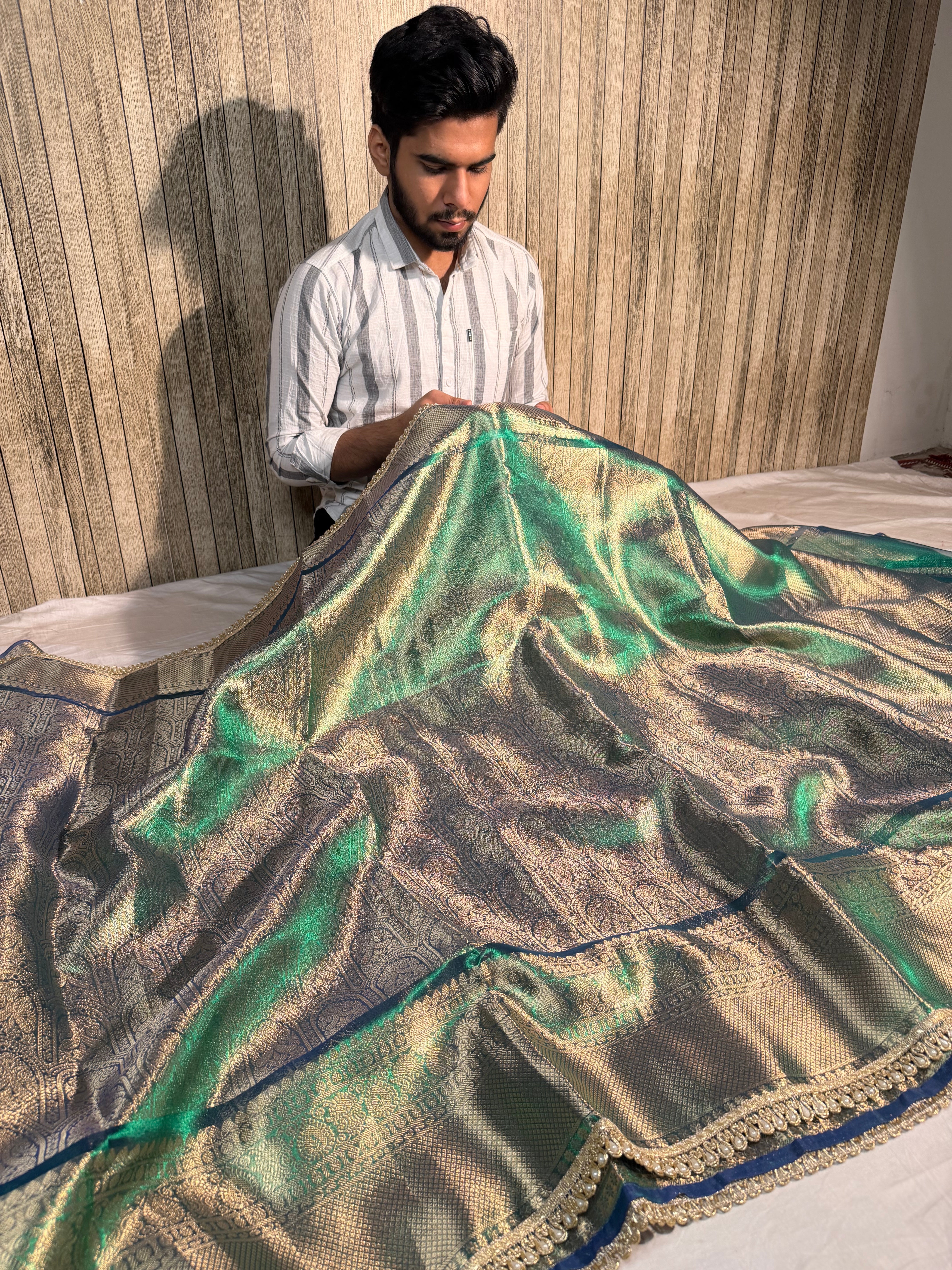
Katan silk is the original Banarasi base, dense, warm, unapologetically rich. It's the fabric of bridal trousseaux and grand reception nights, with a weight and structure that photographs with real depth. Tissue silk sits at the opposite end, with a sheer metallic sheen that almost feels like gold woven into air. It works beautifully for festive evenings where you want shimmer without the heaviness. Chiniya silk, spun from ultra-fine, high-twist yarn, drapes more fluidly and suits pre-wedding functions or receptions where comfort over many hours matters as much as how it looks.
Organza, Georgette, and when a lighter Banarasi makes more sense
Organza Banarasi sarees have a crisp, structured fall with a translucent quality that photographs beautifully in natural light. They're increasingly popular for daytime weddings and festive lunches where you want presence without heavy silk's formality. Georgette Banarasi sarees are the most contemporary of the group, soft, flowy, and genuinely forgiving to drape, which makes them a good fit for cocktail evenings and family functions where you want ethnic elegance without rigidity.
Neither Organza nor Georgette is a compromise, honestly. They just serve different occasions and body types better than Katan would. These lighter fabrics also tend to sit in a more accessible price bracket, making a well curated Banarasi brocade saree in Georgette or Organza a practical pick for festive and pre-wedding occasions without the full investment of pure silk.
Weaving techniques worth paying for
Two sarees can look nearly identical in a photo yet represent completely different levels of skill and time. A standard handloom Banarasi takes roughly 150 to 200 hours to complete, spread across several weeks depending on the weaver's schedule. Knowing the weave types helps you understand what you're actually paying for.
Jangla, Kadwa, and Tanchoi
Jangla weaves feature dense, all over foliage and floral patterns built from continuous zari threads. They're among the most labour intensive Banarasi styles, typically needing 30 to 45 days of focused work per saree, well beyond the standard handloom timeline. Kadwa weaving creates individual motifs without floating threads on the reverse, making the back finish almost as clean as the front. It's considered the oldest, most prestigious technique, and often commands a premium because every motif is woven individually by hand. If a saree's described as Kadwa woven and the seller can show you a clean reverse to prove it, that's a genuine quality signal worth the premium, though it's always worth asking for that verification, since the term does get misused occasionally.
Tanchoi, known for its signature paisley and geometric patterns, is lighter than Katan and suits cultural events and office occasions particularly well. Its understated refinement makes it a versatile pick within designer Banarasi collections for buyers who want craftsmanship without full ceremony.
Cutwork and Meenakari: the newer design languages
Cutwork Banarasi sarees create a lace-like effect by removing certain weft threads after weaving, producing an open, delicate pattern that's visually striking without heavy embellishment. The reverse of a Cutwork saree shows trimmed floating threads, one easy way to spot the technique. Meenakari introduces colour directly into the zari work, weaving silk threads of contrasting shades alongside gold or silver to create jewel toned patterns that stand apart from the traditional gold on silk palette.
Both have become central to designer Banarasi collections aimed at younger buyers who want heirloom craft with a more contemporary sensibility.
How to verify zari quality and authenticity
Three checks every buyer should know
The reverse side check is the easiest place to start. Most genuine handwoven Banarasi sarees, Kadwa work being the notable exception, show floating threads and small knots between motifs on the back. Power loom copies tend to have a uniformly flat, clean reverse regardless of weave style. The zari scratch test works well too, scratch the metallic thread gently with a fingernail. Real zari reveals a reddish silk base underneath, synthetic zari exposes white or plastic like fibres.
For anything you're buying online, ask for a short video of both the face and the reverse in natural light. Photos are easy to touch up, but reverse side footage in daylight isn't. Most reputable sellers will accommodate this without hesitation. If a seller flatly refuses, check whether the platform offers a return window or buyer protection, and treat that refusal as a meaningful signal about the product.
Silk Mark and GI tags: what they confirm
The Silk Mark label, issued by the Silk Mark Organisation of India, certifies the fabric is pure silk and carries a unique hologram on each tag. The GI tag confirms the saree was actually woven in Varanasi, protecting you against imitations made elsewhere. Reputable sellers display both on the product page or hand them over on request.
Missing certifications don't automatically disqualify a saree at lower price points. For higher value purchases, though, requesting both certifications along with zari authenticity details is the most straightforward way to confirm what you're being told.
Pricing a designer Banarasi for your occasion and budget
Pricing varies quite a bit here, and knowing the honest ranges protects you from both overpaying and falling for a suspiciously low price.
In the ₹8,000 to ₹18,000 range, well curated Georgette and Organza Banarasi sarees with machine assisted zari work are realistic for festive occasions and pre-wedding functions. Between roughly ₹18,000 and ₹40,000, certified Chiniya Silk and Tissue Silk bridal options with genuine handloom origins become accessible for receptions and milestone celebrations, though prices within this band shift depending on brand and weave complexity. Above ₹40,000, pure Katan silk with real zari, GI tagged provenance, and 150 to 200 hours of weaving defines the bridal and heirloom category, with many heritage pieces starting near the top of that range. Ultra-luxury Jangla or real zari pieces from established heritage weavers can climb considerably higher, driven by metal content and weaving hours rather than any fixed entry point.
The advantage of sourcing from a brand directly connected to Varanasi's weaving ecosystem is real: access, traceability, and curation grounded in actual craft knowledge. The Surreal Store offers designer Banarasi sarees across Tissue Silk, Chiniya Silk, Organza Silk, Georgette, and Mashru Katan, built to serve different occasions without unnecessary markup, and free shipping, Cash on Delivery, and Ready to Wear options make the buying experience genuinely accessible for first time shoppers.
Styling a designer Banarasi for weddings and modern occasions
Bridal and reception looks: when opulence is the brief
For bridal wear, a Katan silk or Jangla weave Banarasi in deep jewel tones, crimson, plum, or bottle green, anchors the look on its own. Heavy zari pallus draped in the Gujarati or Seedha pallu style photograph exceptionally well under event lighting. The blouse plays a bigger role than people expect. A deep neck or sleeveless blouse in the same fabric extends the luxury feel, while a contrasting brocade blouse creates a nice bit of visual tension that works beautifully at receptions.
For reception nights, a Banarasi tissue saree in gold or champagne with a restrained zari border lets your jewellery do more of the talking. A sweetheart neckline or halter blouse in a complementary shade keeps things polished without competing with the saree's own detail.
Festive occasions and daytime styling
Organza and Chiniya Silk designer Banarasi sarees in pastel shades work beautifully for daytime festivals, mehndi ceremonies, and family puja events where you want colour without formality. Certain minimal, structured drape styles have become particularly aspirational in recent festive seasons, especially looks that let a heritage silk carry the outfit while the styling around it stays deliberately understated.
Pair these looks with a simple chignon, stud earrings, and a matching or contrast blouse for something that reads polished rather than overdressed.
Making your final decision
The framework here is fairly simple once you have the right context. Start with the fabric that suits your occasion. Then confirm the weave style matches your aesthetic and comfort needs. For higher value purchases, verify the zari and request certifications before paying. Finally, choose a seller with transparent sourcing, visible product detail, and a willingness to show you the reverse of the saree on request.
"Designer" in the Banarasi world is really about design intention and craft integrity, not just price or embellishment. A well designed Chiniya Silk saree from a Varanasi rooted curator can genuinely outshine a heavily marketed piece at triple the price, if the fabric, weave, and occasion actually fit together.
Worth starting with The Surreal Store's fresh arrivals or the celebrity-inspired edits if you're shopping for a bridal look, a festive occasion, or a gift that'll actually be remembered. For anyone new to saree draping, the Ready to Wear options remove the last practical barrier between you and one of India's most enduring textile traditions.
FAQs
1. What makes a Banarasi saree a designer saree?
A designer Banarasi saree combines traditional handloom weaving techniques with modern colors, motifs, blouse designs, and styling while preserving authentic Banarasi craftsmanship.
2. Which fabric is best for a designer Banarasi saree?
Katan Silk is ideal for bridal and wedding wear, Tissue Silk offers elegant shimmer, Chiniya Silk provides lightweight luxury, while Organza and Georgette are perfect for festive and daytime occasions.
3. How can I verify an authentic designer Banarasi saree?
Check for Silk Mark certification, GI Tag, genuine handloom weaving, quality zari work, and ask for images or videos of both the front and reverse side before purchasing.
4. Which Banarasi weave is considered the most premium?
Kadwa weaving is regarded as one of the finest Banarasi weaving techniques because each motif is woven individually by hand, resulting in exceptional craftsmanship and durability.
5. What is the average price of a designer Banarasi saree?
Designer Banarasi sarees typically range from ₹8,000 for Organza and Georgette styles to ₹40,000+ for authentic Katan Silk, Jangla, and premium bridal collections.
6. Why choose The Surreal Store for designer Banarasi sarees?
The Surreal Store offers Varanasi rooted designer Banarasi sarees in Katan Silk, Tissue Silk, Chiniya Silk, Organza, Georgette, and Mashru Katan with authentic craftsmanship, Ready to Wear options, Cash on Delivery, and nationwide shipping.